Tuesday, March 8, 2016

Monday, March 7, 2016
Content Outline- my podcast's
Open:
Opener Line
- Clearly introduce self and topic.
- Snappy.
- With Personality- sets tone and gives a reason to keep listening.
Subject Intro
- Define scope- any professional writing in a physics career.
- Not just research papers.
- Give some idea of research done- establish credibility, do not overdue- that would be boring and pointless.
- Reason to care? -Physics is awesome?
Body:
1) Misc. Writings
- Outreach stuff -Manne on why it matters (gets people into the field, opens doors), examples here.
- Recommendation Letters- Manne: Selling strengths, spinning weaknesses, very important to students career, assumed baseline positivity- don't undersell.
2) The Research Paper
- Sterile- Keep it brief and to the point.
- Standard organization- Look at any research paper
- Taught in lab reports
- Conventions designed to promote clarity and impartiality.
3) The Narrative of a Research Paper
- Helps convey results and how they were found.
- Keeps interest. -We were looking for x and we found it opposed to we did y and saw x.
- Manne quote
- Wolgemuth quote
- Surprised me; essential to a good paper according to interviewees
4) Speaking
Conferences
- Attending talks.
- Thesis defense.
Class
- Learn as you go -Manne
- TAship?
- Important part of the job; doesn't seem to usually be formally taught
5) Grant Request?
- Non-expert level.
- Why is this worth money?
- Necessary to research.
- Wolgemuth on differences with Bio grant- less hypothesis oriented, can be more of a "interesting question.
Close:
Writing in Physics is not a monolithic entirely sterile form, though some of it is. Anyone interested in Physics should get to know its writings beyond the common perceptions. Knowing the conventions behind the writings helps one better understand appreciate the writings. A knowledge of such subtleties can also be greatly useful to anyone looking to improve their own writing in the field.
Outro: This has been...
Sunday, March 6, 2016
Academic Discourse and Genre
The main of the American Journal of Physics is made up of article simply referred to as Papers. These Papers serve to communicate a subject on a non-expert level and to show how the subject might be taught. The text largely follows the standard scientific paper format with well defined, labeled sections. The introduction and background section tend to be far longer than typical.
Near the back of the Journal reside the Notes and Discussions. I see these more commonly called something along the lines of Comments or replies. They're through responses to previous articles or comments often in the form of "you're wrong and this is why".
Right at the back are a couple of Book Reviews. They are highly descriptive, taking up nearly a page.
The Journal begins this issue with a call for a new editor. Followed by a letter to the previous one.
Right at the back are a couple of Book Reviews. They are highly descriptive, taking up nearly a page.
The Journal begins this issue with a call for a new editor. Followed by a letter to the previous one.
Some definitions;
Papers- A multi. page text in the format of a scientific report.
Comments- Through point by point replies to articles and other comments. Often corrections.
Reviews- Book reviews in about half page essay form.
Help Wanted Ad- job posting for a new editor complete with description of duties and requisites.
Letters to the Editor- A short letter from a reader expounding on a previous article.
Comments- Through point by point replies to articles and other comments. Often corrections.
Reviews- Book reviews in about half page essay form.
Help Wanted Ad- job posting for a new editor complete with description of duties and requisites.
Letters to the Editor- A short letter from a reader expounding on a previous article.
Rhetorical Analysis of an Acedemic Journal
The library didn't carry print copies of any of the journals I looked at in my last post so I chose to examine the American Journal of Physics.

This journal seems to have an interesting policy with its authors. The authors are listed only by name and place of work. More interesting, is the variety of authors. Most of the authors are from US universities, but some are from abroad. One article even has several high school authors.
The primary audience of this journal is people teaching physics at the graduate and undergraduate levels. The content tells how to teach various subjects and explains the same for people with a background in physics though not necessarily in the specific field. The secondary audience is teachers and students reading to broaden their understanding of various fields.
The only major current event that I think may have affected this issue is that the journal is seeking a new editor. I wasn't able to detect any effect this had on the journal.
I think that this journal exists to better physics teaching. From the non-expert level of required background to the inclusion of high school authors, The entire journal seems to say "you can learn/teach anything in physics".

This journal seems to have an interesting policy with its authors. The authors are listed only by name and place of work. More interesting, is the variety of authors. Most of the authors are from US universities, but some are from abroad. One article even has several high school authors.
The primary audience of this journal is people teaching physics at the graduate and undergraduate levels. The content tells how to teach various subjects and explains the same for people with a background in physics though not necessarily in the specific field. The secondary audience is teachers and students reading to broaden their understanding of various fields.
The only major current event that I think may have affected this issue is that the journal is seeking a new editor. I wasn't able to detect any effect this had on the journal.
I think that this journal exists to better physics teaching. From the non-expert level of required background to the inclusion of high school authors, The entire journal seems to say "you can learn/teach anything in physics".
My Major -physics is
Students in my major are taught to understand and manipulate situations governed by the laws of physics, especially where these situations differ from standard intuition. The more practical skills learned involve the operation of laboratory environments and complex problem solving. This training provides a good base, but does not always prepare a student for their particular career.
Physicists can end up in a wide variety of fields ranging from education to medicine. The skills developed in a physics education can apply to most fields requiring the operation of advanced machinery or analysis of complex operations.
I chose to study physics because I find the kind of problem solving and discovery fun. The most exciting work in the field has gained a good bit of attention recently. Everything that CERN does is awesome in the old sense of the word. The LIGO Gravity wave discovery has everyone ecstatic. Biophysics in general is always doing something interesting.
Some of the bigger journals in Physics follow;
-Reviews of Modern Physics
-Nature Physics
-Physics Report
-Nature Materials
Physicists can end up in a wide variety of fields ranging from education to medicine. The skills developed in a physics education can apply to most fields requiring the operation of advanced machinery or analysis of complex operations.
I chose to study physics because I find the kind of problem solving and discovery fun. The most exciting work in the field has gained a good bit of attention recently. Everything that CERN does is awesome in the old sense of the word. The LIGO Gravity wave discovery has everyone ecstatic. Biophysics in general is always doing something interesting.
Some of the bigger journals in Physics follow;
-Reviews of Modern Physics
-Nature Physics
-Physics Report
-Nature Materials
My Interviewees on Social Media. -the presence of
Professor Manne, my first interviewee, is not on any social media. He thinks that new people to the field should probably use it to their advantage, but he feels that he entered the feild early enough that it won't be necessary for him.
My second interviewee, Professor Wolgemuth, has a brief Linked in page, but his biggest use of social media is Youtube. His research team has their own channel. They use this channel to host videos taken in their research for easy access. The videos on this channel are largely raw footage and are far less polished than the associated papers.
My second interviewee, Professor Wolgemuth, has a brief Linked in page, but his biggest use of social media is Youtube. His research team has their own channel. They use this channel to host videos taken in their research for easy access. The videos on this channel are largely raw footage and are far less polished than the associated papers.
Sunday, February 28, 2016
My Interviewees as Professional Writers
My two interviewees are both researching Professors in the Department of Physics. As such the main of their publications take the form of reports on experiments in scientific journals.
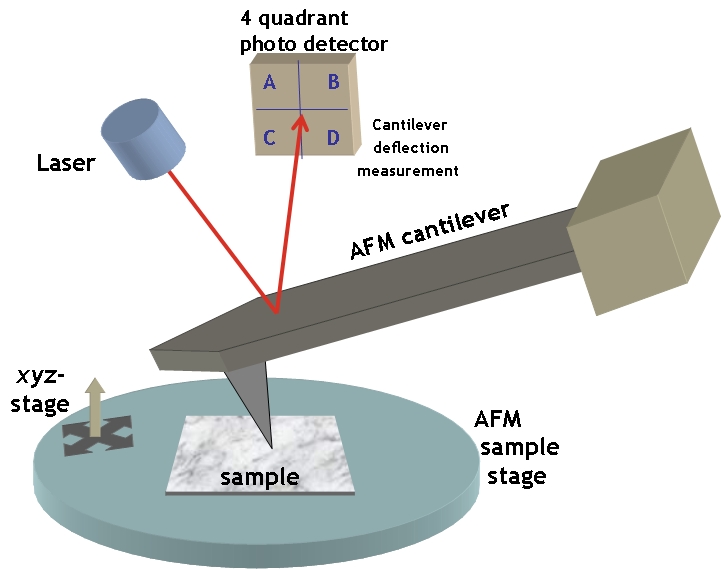
Kristian Mølhave How an atomic force microscope works. for the Opensource Handbook of Nanoscience and Nanotechnology 3 October 2013 Wikipedia
CC Attribution 2.5
My first interviewee is Professor Srin Manne. Dr. Manne's research focuses on condensed matter physics and often uses Atomic-force Microscopy(AfM), an imaging technique that can study a material at a far higher resolution than any optical microscope. His publications include entries that instruct in the use of AfM. Dr. Manne is particularly interested in undergraduate research. Dr. Manne is well published, and writes in a variety of fields. Condensed matter research can fall under many different fields.Electrochemistry on a gold surface observed with the atomic force microscope is a paper by Manne et al. on an experiment they conducted observing the oxidation of a gold surface with an AfM. The paper is in the standard form that science students are taught in lab reports. This paper was published in 1991, 9 years after the introduction of the AfM but before many of the advancements in modern AfMs.
Atomic Force Microscopy of the Nacreous Layer in Mollusc Shells in Proceedings of the Royal Society B is a paper by Manne et al. about an experiment studying Mollusk shells with an AfM. This paper follows the same experiment report conventions taught in science classes. The experiment was a cross department and university effort with UC Santa Barbara's Physics, Chemistry, and Biology departments credited, along with the University of Bath's School of Chemistry.

The Company of Biologists Long-range movement of a midbody remnant over the cell surface of HeLa cell. Jan 20, 2015 Youtube
CC Attribution
My second interviewee is Professor Charles Wolgemuth. Dr. Wolgemuth's research studies cellular movement. He studies how individual cells and groups of cells use the laws of physics to propel themselves. He publishes in both Physics and Biology journals.
Crawling Cells Can Close Wounds without Purse Strings or Signaling is a piece by Wolgemuth and Pilhwa Lee. It describes how cuts heal on the cellular level. Better understanding the mechanics of healing could prove important to learning to better treat wounds. The text itself follows the standard experimental report conventions.
Subscribe to:
Posts (Atom)